Wednesday, January 29, 2014

Why Supernauts is not going to fly

Supernauts is a game made by Finnish game studio Grand Cru. The game has been in the development at least two years; I first heard it back in early 2012 when I was visiting Start-Up Sauna in Helsinki. It is the game that has been anticipated by the Finnish gaming community and personally, by me.

The game has been under testing in New Zealand, Canada and bunch of other countries at least from October 2013 (the what I have found out from App Annie records).

To describe the game in the shortest form, it's a game which mixes game-play features from Minecraft and Farmville. In essence, the goal of the game is to build and upgrade player's own little lot of land in the space by producing different kinds of materials using special machinery which produces them, solve puzzles in mission mode and play together with friends (which means visiting other player's land, give gifts and chat).


It is the game that in paper, sounds like a dream come true to casual / mid-core gamer like me who doesn't have so much free time to invest into more hard core games, but still want to do something creative, engaging and social with ease of current smartphones and tablets. It is the game that features stunning casual graphics, great sounds and full-fledged 3D-camera which can be rotated, zoomed and pivoted. The production speeds, in-game currency, progression and social elements are also implemented in a way that at least I couldn't find any major bottlenecks in them.


Better quality download ranks of Supernauts here.


Better quality grossing ranks of Supernauts here.

Still, in my honest opinion, it feels that the game misses something. Something which would tie all of those great features together, engage players to the game and keep them engaged. This notion of mine was confirmed when I fetched the estimations from App Annie's portal which clearly shows that the game could be much better in terms of download or grossing ranks. The game has hovered between #20 - #390 of Simulation and Adventure categories in Canadian App Store. In addition, the graphs of download ranks tell that the game is not taking off because the rank position in the download ranks decrease drastically after the release exposure (either by featuring or user acquisition) of new update of the game.

Consequently, the grossing rank features similar phenomenon; curves are shifting rapidly downwards and upwards when new content is added and new user acquisition campaigns started to get big enough cohorts to test new features and updates to the game. Unfortunately as of today, the curve tells their blunt and ruthless truth: lines are going downwards.

Missing Link

So what causes the game, which is created by experienced professionals, developed in the country whose drinking water should contain something which creates likes of Supercell and Rovio, and financed by sharp and cautious investors who do rigorous analysis of the capabilities of the team and profitability of the product(s), to showcase serious performance issues?

In my opinion, it is not the monetization aspects, not the graphics, sounds or bugs in the game and not even the camera which - in it's own right - might cause more casually oriented players to leave the game. 

The key to problems is the core loop of the game and its inherent social mechanics.

Core Loop & Social Mechanics


First of all, the core loop of the game doesn't differ much from the core-loop of first social simulation games, e.g. Farm Ville. Core loop of Supernauts consists of following actions.

1. Producing resources. The game features different kinds of resources which the player has to produce in order to progress in the game. Let's call the first resource type as naturals which are produced either in Claymaker (clay), in Logmaker (log / timber), in Stonemaker (stone) or in similar kinds of makers. These naturals are then used to produce more refined resources (materials) such as brick, stone, cement, paper and all sorts of different materials which are produced in different types of Bots. When player progresses, he will need to mix also the materials together in the Bots in order to make even better materials for his use.

The makers, bots and production of resources will cost coins (soft currency) and will take time.

After player has produced resources, he can decide whether to 1) sell them in Block Exchange (to virtual buyers in the game, not to real human players), 2) to use them in the quests or 3) use them to upgrade player's own asteroid.

2a. Selling resources.  Selling resources is typical feature of social simulation & mgmt games; you produce the goods with the cost of money and you sell the goods and you get money. Simple and effective, ain't it? Well, to be honest, it would be if the same mechanic wouldn't be operated already in plethora of other games already starting from Zynga's Facebook games like Farmville 2 and the likes.

So in short, players can sell their resources to the randomly generated virtual customers in Block Exchange. Customers and their needs in Block Exchange will expire in certain time-frames which could be a great for increasing engagement, but unfortunately the user has to initiate requests of new customers after the old ones have been expired. Therefore, the game cannot send any notifications to the player to communicate the arrival of new customers.

Players can sell their resources in Block Exchange 


2b. Use resources in quests. Quests are small missions which consists of similar smaller actions than upgrading player's own asteroid. Typically the player has to complete some unfinished construction of a building when he unlocks more land around his asteroid. In reward of completing a quest, the player gets coins, experience and game's own reputation units; "fanciness". (Sorry for blunt translation - I don't know what "fantsut" means in English since I only have the Finnish version in my device).


2c. Construct more buildings  Player's third option for using the resources is use them to make more buildings onto his asteroid. The more and better resources the player uses to construct buildings, the more reputation - fanciness - the player will get.

Below you can find the visualization of the core loop. Better quality picture of it here.


Summary

To summarize my finding, Supernauts' core loop and social mechanics are not optimal for following reasons:

1. Old, familiar core loop. Although Grand Cru has invested a lot of money into developing a game which looks amazing in high-end mobile devices with Retina displays, it doesn't change the fact that exactly the same core loop has been used in several other games already.

Result: players will quickly realize old core loops inside the games and the fact there isn't anything new under the hood compared to much older games already out there. Just improving graphics doesn't make the core loop any more engaging than they are in already published games.

2. No skills required. Supernauts is a game where you don't have to be particularly skilful in order to progress more rapidly in the game which is why the game is not engaging for contemporary mobile gamers. In my opinion mobile platforms and consumers will go more and more towards direction where it is not sufficient any more to hold on to shallow core loops where players just produce stuff, sell stuff and buy stuff in order to progress faster - or use money to do the same.


Sadly, even if the player would be more tolerant towards the mechanics and grind their way up the ladders of the game, the core loop doesn't get any more exciting. Sure, there comes more and more different kinds of resources and machines which produce new kinds of resources but that's it, the basic actions (produce, sell, build) of the game doesn't get any fascinating after the first week of gaming experience.

Result: players will see through that shallow loop which is based on busywork and will not spend any more time in the game.

3. Shallow social mechanics. In the game, players can visit other players' home bases (asteroids), give them gifts (limited amount of resources), sell ice-cream to citizens of fellow player and to chat with other players in real-time. Unfortunately these actions which players are able to do in the game are not enough for conscious contemporary player and consumer.

Players are already got used to much stronger social mechanics which can be found already in Clash of Clans (donations inside clans, attacking other players), Hay Day (selling goods to other players, helping other players in their quests) and Candy Crush Saga (seeing how far friends are already).

Result: players want to collaborate, compete and discover together in the games, not just co-exist in the game.

For these reasons I assume that the game will not fly very high. Only way to change this state is to change the core loop of the game which cannot be done post-release.  But let's see, it is interesting to see how things will evolve for Supernauts.


Thursday, January 16, 2014

How The Simpsons - Tapped Out is making money


Recent news about EA’s new The Simpsons – Tapped Out game shows that tablet-optimized social game earned more than $23 million during Q3 2012.

So what makes Tapped Out so engaging gaming experience that it a) retains users and b) monetizes them so that it makes so big numbers for EA? Let’s check it out!

The back-story of the game is that Homer accidentally was so engaged into playing the tablet game of Tapped Out that he forgot to watch out nuclear plant meters which of course caused plant to explode and blow away whole Springfield. Player’s goal is to help Homer to rebuild Springfield and invite the old inhabitants back to Springfield.

Look and feel of the game is genuine Simpson-style. Game uses same graphical style, character voices and the humor which people has used to experience when watching The Simpsons on TV. The controls of game itself are well optimized for touch devices; touch controls are quick and accurate and user interface logic suits well for mobile devices with large screens.

Game has two in-game currencies, namely the usual soft currency which in this case is cash and the hard currency which is branded in the Simpson-style as donuts. Soft currency is the primary currency of the game and player can buy most of the items with soft currency except some special buildings and items. Player can earn only small amounts of hard currency in the game by leveling up or inviting friends. Hard currency is mainly used for speeding up and to buy some premium items.

Core Loop

The game features one dimensional core loop. The loop consists of building more building to player’s own town and collecting most well-known characters of the franchise by that. Constructing the buildings take time and money, but earns experience to the player. Collecting different characters compels to humans primal “hunt & gather” instinct which is why these kinds of loops are very successful in games.

The more buildings player can construct to town, the more taxes (cash + XP) he can collect from them. Different buildings have different waiting times which player has to wait (or pay) in order to collect taxes. Also, different buildings have different amounts of taxes which can be collected from them.

Another element to the core loop is managing the life of the inhabitants. Every character in the town has his / hers own little “yellowish” chores to do in the game. In general the chores  do not affect the appearance or core-loop of the game, but are more like
busywork; keeping players busy and adding another monetization layer to the game but at the same time, creating emotional bonds to the characters and creating feeling of “my town”. In my opinion busy-work don't add the value of the game but still they are quite widely used throughout social games.


Lisa's chore-list = busywork
In addition to basic core loop, the game features also mechanic called “Conform-o-meter”. Conform-o-meter measures how well player can grow town so that special meters fill up. These meters include e.g. Consumerism, Vanity and Socialism among others and they measure how well the inhabitants can go to shopping, how well decorated the town is and how well player has made friends and visited their towns. Game rewards the player for reaching the meters with added money and XP.


Visit my town! a.k.a the Virality

Some would want to know how the social aspects show up in the game because – after all – this is social game. So let’s dive and see how social this game truly is.

Game includes popular social hooks / invites. This means that player can invite friends to join as his neighbors by using channels such as EA’s own Origin -network, Facebook, Google Mail or iOS device’s contacts. Everyone has to join to Origin in order to use social features, but luckily the registration process in-game is fairly easy to do.
View from the neighbourhood

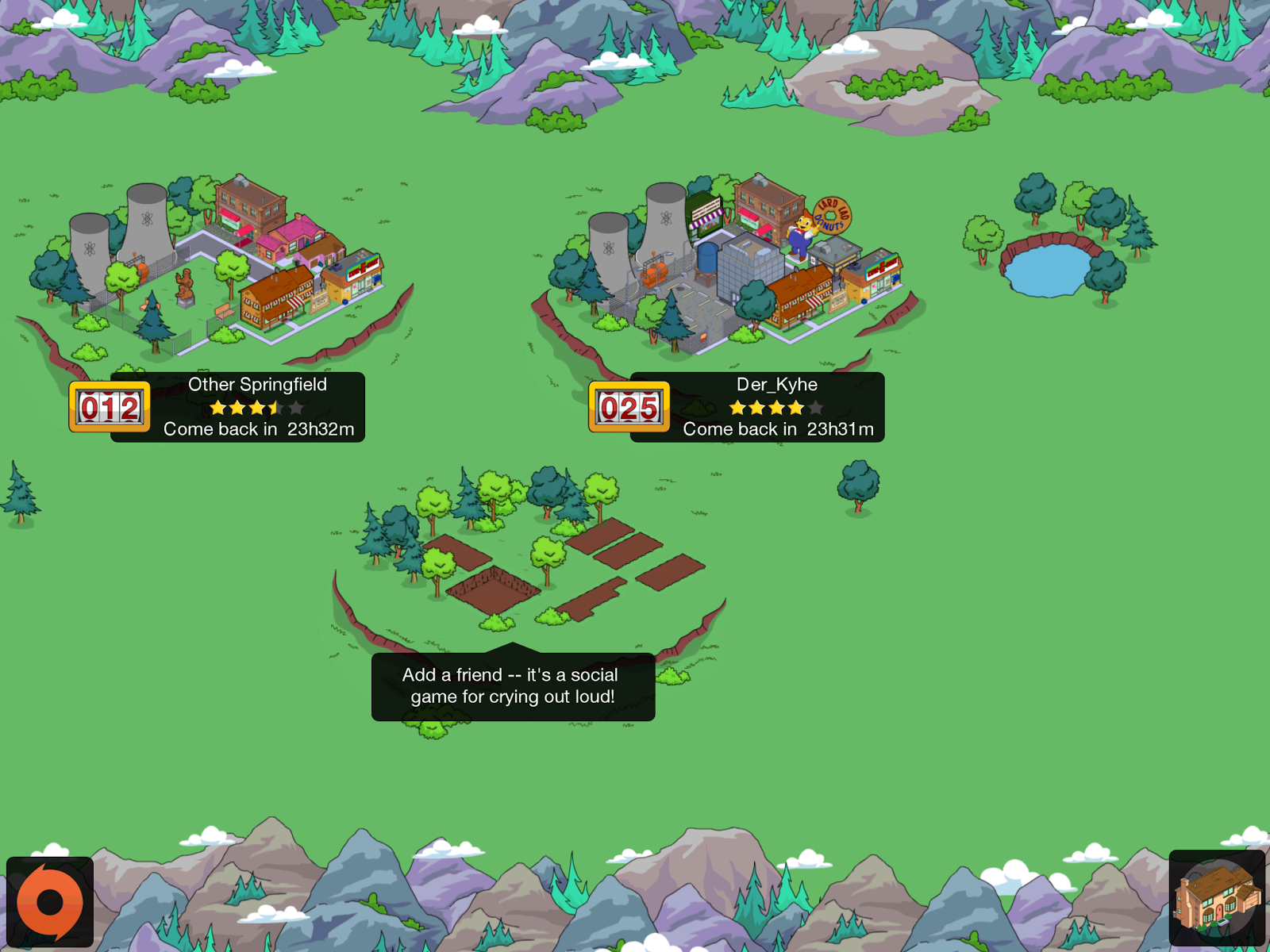
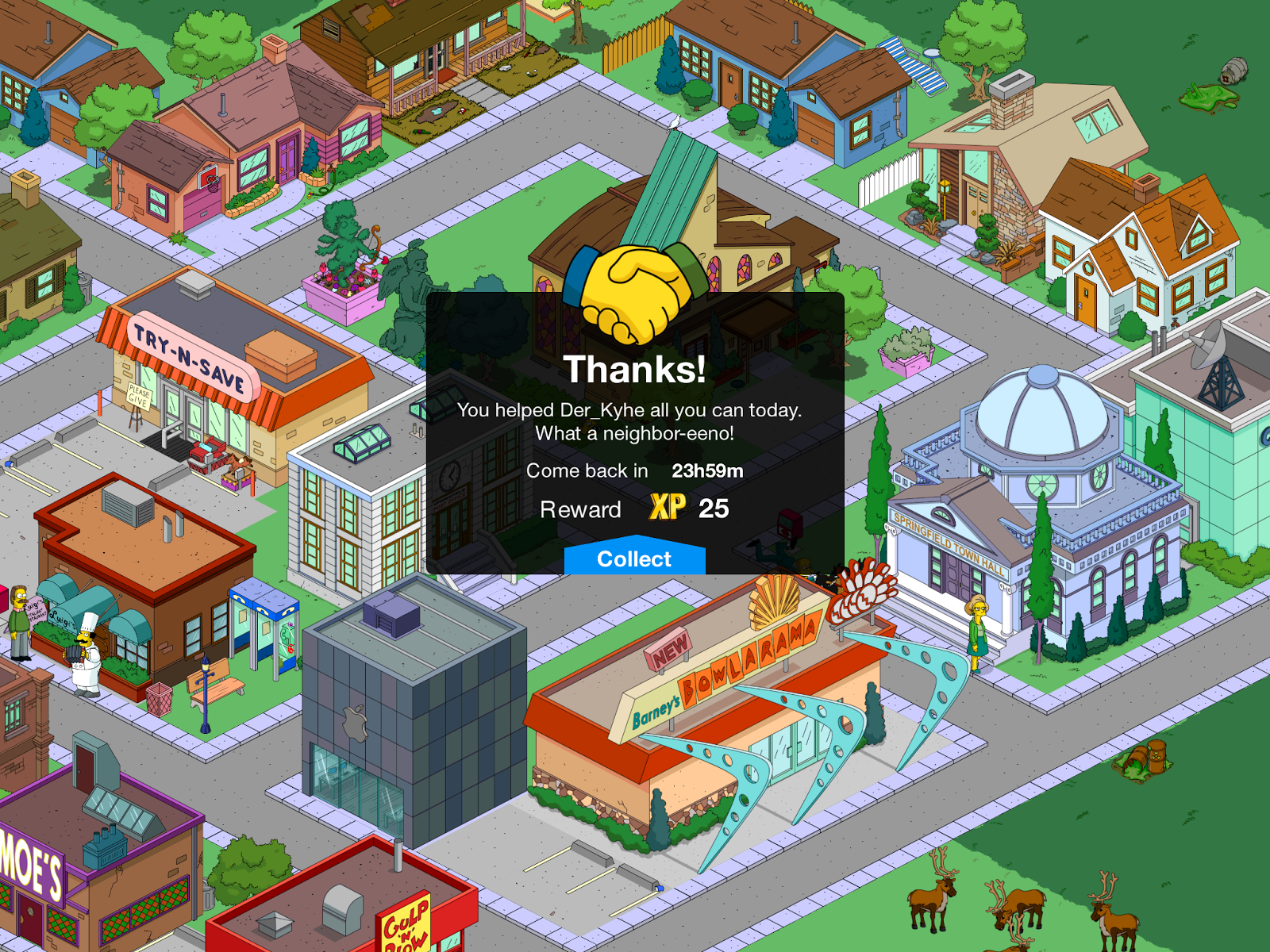
Tapped Out’s only social feature inside the game is the ability to visit player’s friends’ towns. In current version of Tapped Out, players visit their friends’ towns in order to send Valentine’s Day cards to the friends and thus helping friends and themselves. Cards are sent by clicking (maximum three times a day per town) the buildings in the town. By clicking buildings players gain more experience, cash and hearts for themselves and for their friends.  Hearts are special kind of in-game currency which players can use to purchase special Valentine’s Day items (limited time around Valentine’s Day). Sending Valentine’s Day cards to friends is easy and rewarding way to integrate the social aspect in the game since it compels users to invite their friends to the game as well.

Sadly this is as far as the game gets in the social mechanics. It’s sad because social mechanic doesn't really affect any other part of the game than the player receiving more experience and in-game currency. Secondly the only feature which the game includes in terms of social aspects is exactly the same thing what e.g.  Zynga did back in the days with their first Facebook games including FarmVille.

It would have not taken much effort to introduce little bit evolved social mechanic to the game where users could help their friends by integrating the help features more into the core loop of the game. 

The Monetization


It’s interesting to see the level of of the cheapest currency-pack goes up and up when the platforms and games evolve. Before iPhone was launched back in the days, Travian, Farmville and bunch of other social games started at 0,49€ currency packs. Now the usual starting price seems to be something like 4 to 5 euros.

In Tapped Out, the minimum price for currency pack is 1,79€ which is mystery for me why that is so low. 
In Tapped Out, player pays for speeding up the progress (constructions and chores) of the game as well as by paying from some special items and buildings. And there’s a LOT of items you can buy only with hard currency. From most expensive item the player has to pay 250 donuts and all the premium stuff together is worth of 2743 donuts. With a maximum one-time IAP of 2400 donuts wih 89,99€

Because the game is so well optimized for DAU (as I explain later), the game could monetize better the players who doesn't want to wait. Now all the waiting is tied to the max 24-hour cycle which decreases the conversion rate from players to payers. 

Engagement

Biggest element for high engagement and thus retention rates are well balanced core-loop and compelling, tablet-optimized gameplay. Core loop is designed to keep DAU high because every task of the characters, building & tax income times of the buildings doesn’t exceed 24h. In addition, the way the rewards of the tasks of the characters, finished buildings and send / received Valentine’s Day cards are showed to the player is very compelling. It’s very rewarding to come back in the next day and tap & see how the rewards fly to oneself on the screen of iPad.

Scratch-R tickets. Can you scratch the itch?

In addition to core loop, Tapped Out includes basic engagement features. First, there are the daily rewards which reward players with money for coming back daily. The cash rewards increases daily for a week and in the last day there is special lottery prize available for player.  After one week the reward loops starts again from the beginning.

Another engagement feature is Daily “Scratch-R” scratching tickets which players can buy with soft currency once per day and if they want buy more, they have to pay hard currency. These kinds of luck-elements are especially popular in Asian countries (according author’s own references) and may monetize very well there.

1st gen social game in 3rd gen platform

I think that Tapped Out is the iteration of 1st gen social game which means that the social aspects of the game doesn't really add value to the core game mechanics but rather just rewards  the player for visiting their friends town with in-game currency.

I think the game has very good retention rates and it monetizes mainly from players who would like to buy the premium stuff or the Asian players for scratching those tickets. It could do better if the game’s progression would be designed to slow down (= longer waiting) after some while from beginning of the game to create primed to spend moments.

The retention rates could be quite easily pulled even higher by enabling players to upgrade their buildings or create ad-hoc relationships between the character of their town. Now the game doesn't give any visual feedback on the progression other than giving and showing piles of in-game currency to players which they can buy more buildings.

Apart from the monetization and retention – or in conjunction with them – the game could do a hell of a lot better with integrating social aspects into the game. The first thing would have been to think easy and creative ways to collaborate and integrate fabulous Simpson characters into it. What could have been funnier than to find and catch (read: tap) “the lost cats of Crazy Cat Lady” and send them back to a friend from whose Crazy Cat’s are they? Or how about enabling players to create their own baseball league championships after they have managed to build the stadium and invite their friends to take part in it? There’s a tons of more good and easily implementable ideas from the franchise which could have been integrated into the game to create more social game.

Apart from the social aspects, I think EA is quite pleased with the numbers what the game has done but I sincerely hope that EA has some ideas waiting to get implemented so that the players would get more value from this social game. Now it just seems that EA has went easy but hollow way of creating social game by copying the basic design principles from early Zynga games which creates good numbers for EA due to high discoverability of The Simpsons franchise, heavy user acquisitions and 24h optimized (but still hollow) progression loop. Simply put it's fist gen social game on a third gen platform.

Four common practices for increasing engagement in f2p mobile games


I thought I would share some effective practices for increasing engagement in f2p mobile games which are not tightly coupled to any particular type of game. With goal of reducing misunderstandings, these of course are not effective if the itself game is bad.

Some of them are very  generally used in games, but not very well implemented in some of them. Here, I will depict my my own thoughts what you should think about before hurrying up with the actual implementation.

Facebook / Social integration

All the time Facebook brings more and more valuable services to mobile game developers for free which greatly increase the engagement of players when they can play against and with each other, compete, brag and send gifts and also compare the progress of their game play to each other. Here's some best practices for integrating Facebook to your game.

Allow players to see each others' progress in a same view where they see their own - Candy Crush Saga does this exceptionally well with its world map and progression line where users can see their own and friends' progress in one shot.


Your own progress and your friends' progress in a one view
Boom Beach allows players to see each others in the map view of the game, but doesn't make any effort to enable players show off with their progression. Small changes either to icons of the players and/or to pictures of bases could add significant ego-boost value to user.


If possible, allow players to challenge each other - Highly effective way of increasing engagement. When you - as a player - has been challenged by other human being, or even better, someone you know, it creates different kind of motivation to show your superiority to other player. If this methods can coupled with push notifications, it's best way to engage players to your game.

Daily gifts

Daily gift is a common way for most game developers to engage those users who come back to game. However, thought should be exercised when designing the visual looks, user experience and user interaction of the daily gift use case. Below my five cent's on daily gifts.

Daily gift  in Diamond Dash by Wooga is well thought. The user experience is rich, the steps to getting the gift from opening the game is low and the more days the player returns to game in a row, the better the prizes are.


Reward players - Don't be a jack-ass and try to deceive players by giving something which is no use for players - players will notice it. On the other hand,  reward the players with usable items and also make the interaction of getting the gift rich.

Don't dilute your game economy - You should also make a living with your game, don't give excessive amount of premium currency for your free-to-play game.

Add element of luck to it - Luck is an important element of daily lives in the Asian cultures and there are huge amount of people in the western countries as well who like to gamble a bit. Don't miss your luck and implement the luck element to your daily gift procedure.

Motivate players to come back, every day - By rewarding players with better rewards when they come back to your game 7 days in a row if very effective strategy for increasing engagement. It's your own loyal customer program!

Think about user experience - This is something which is very hard for most developers to effectively understand. Supercell does this well in Hay Day in one use case where players can search and tap those special mystery boxes and find some items or money from those. Boxes and the way of getting items from them fits perfectly to the game and to the general user interaction scheme in it.

As a developer, you should reduce the number of steps which are required from the player to get the daily gift, but also the daily gift mechanic should fit to the style of your game and to general interaction scheme so that the players can use it.

Achievements / Missions

Achievements increases engagement for the achievers. The people who always wanted to have a-grades from every test and project. Achievements should be designed in a way that during the first seven days in the game, players could achieve at least one achievement per day to keep him engaged. After the first week, the pace could decrease to one achievement per two days. If you can reward player for getting achievement it naturally increases the engagement.

Also think about rewarding players with permanent decorative items after they have completed the mission/quest/achievement so that they can show off to other players in the game. 


Notifications

Notifications are very commonly used in mobile games because they are easy to implement and (seemingly) are tremendously effective in engaging users.

But looks might be deceiving. Even if the notifications could (remember that user can always opt out of having notifications) appear to user's device's screen it's too usual that the content in the notifications are too trivial, irrelevant or they appear too often so that the user either doesn't care or gets irritated and decides either to turn off notifications or uninstall the game.

Here are some tips for fine-tuning the notifications.

Stay relevant - Think about the player and things which might actually help her to be better in the game and not just throw out a bunch of pre-scheduled notifications reminding player to come back to game. Think about triggering notifications to events in the game which could help the player in the game. For example, notifying player when the castle has been built or when energy has been refilled or when other player has attacked to your village.

Stay short - the more shorter way you can express your message, the better and more understandable it is. Period. (Also, Apple limits push notifications' payload to 256 bytes, damn.)

Be surprising - I still remember how dazzled I was when I was heard Homer Simpson's voice from my iPad when Simpsons - Tapped Out was reminding me that taxes of the residents in my Springfield were due. Damn! That was surprising!

Let players decide - In addition to allow users to turn off notifications it's a good practise to allow user decide what kinds of notifications (local, push, voice, text etc.) they want to receive and how often. If they truly are engaged to your game, they will use it.

So here's short list of commonly used practices to increasing engagement in mobile games with additional hints from me.

But as I'm always hungry to learn more and going deeper I want to know what kinds of strategies for player engagement have you been using or seeing in games? Please share them in the comments!

Monday, January 13, 2014

Supecell's next game Boom Beach analyzed


As most eager fans have already seen, Supercell has been testing their next mobile game Supercell in Canadian App Store. Boom Beach was launched in Canada in 8th of November 2013 and it still is "under testing" in Canada.

Let's dig through the main game pillars of the game, analyze how it differs from Clash of Clans in terms of gameplay, monetization and engagement aspects and finally, let's discuss how these changes might affect the core audience of the game.

Gameplay

Baseview from Boom Beach
For any of you who don't know what Boom Beach is, it is a strategy management game - similar to Clash of Clans. The main goal of the game is to develop one's own military base and conquer surrounding islands from AI-players and other human players by accessing the map view from in-game ui.

Obviously, the first main difference is that instead of medieval-fantasy theme what is used in Clash of Clans, the theme is now military. Basic troops consists of Riflemen, Heavys, and Zookas which all have their own strengths and weaknesses and basic buildings are military bases, residence buildings, gold storages, sniper towers, mortars and machine guns, to name a few.

Second distinct difference is that battles against AI-controlled enemies and human opponents can be accessed from one single map view.  How much world is uncovered from fog of war depends on the level of the Radar building and the urge of the player to spend gold to unlock areas from fog of war (unlocking areas costs gold, you know). 

Third big difference in the gameplay is that controlling of troops in the battle is a little bit more direct now. In Boom Beach player can control the target position of all the units in the battle by placing a flare in to the position where he wants the troops to go. But the tricky part is that the flares last only a certain amount of time and when they end, troops will start to attack to the nearest possible building from their position. So if the target position of the flare is too far away from the troops, they will never make it so far and might disrupt the whole attack plan of the player.

Fourth big difference in the battle mode of Boom Beach compare to Clash of Clans is the introduction of energy points and consumables to battles. Here's how they work: first, the base amount of energy points the player has is dictated by the level of the gunboat - the better the level the more energy points. Secondly, players can collect energy points during battles by destroying enemy buildings. Thirdly, player can use these energy points to use consumables such as flares, artillery, medkits and shock bombs which could have a big impact to the battle if used wisely.

And finally, the fifth big difference in the battles in Boom Beach is that the Headquarters acts as "all or nothing" type of building which means that if enemy can destroy the Headquarters, the battle is lost. Also, the health level of Headquarters is an effect of health level other buildings in the village. This means that if enemy can destroy the gold storage of your camp, the health of Headquarters decreases a bit. However, this doesn't mean that by destroying all other buildings in the camp, the result would be destroyed Headquarters.

In my opinion, with these design decisions, Supercell has created a game which is more "core" than it's previous game Clash of Clans mainly because of the depth of the battles. At least for me, there are far more variables to consider when planning the attack against other players and maybe that's why Supercell hasn't limited the amount of time the player can scout camps of enemy players. Also, fewer unit amounts and more direct controlling of the troops during battles creates more engaging battle gameplay experiences for the players.

Monetization

In terms of monetization there are quite a few elements to inspect to really get a grip on monetization aspect of the game

Virtual Currencies and Resources
First, let's go through types and amount of virtual currencies and resources in Boom Beach. There are three different types of virtual currencies in Boom Beach: Gold, Wood, Stone, Iron and one premium currency Diamonds. 

Gold is produced by the residence buildings; the more the player has these and the higher level they are, the more they produce gold in an hour. 

Wood is produced by Sawmill to which the same rules apply - the higher the level, the more it comes.

Stone is produced by the Quarry.

In addition to these basic resource production building which are directly accessed by the player, considerable amount of gold, wood and stone comes from the resource bases and which are conquerable by the human opponents in the game. Player can also gain these resource by winning battles in the game.

Gold is mainly used to train more units, to clear more area in the map, to fight battles and to research better types of power-ups from the Combat Academy. These are all "gold only" types of productions. Wood and stone are mainly used to construct and upgrade buildings and gunboat in the home base. 

From my gameplay experience it seems that stone is the most rare and sought after resource at least to player HQ level 7 (I have no experience from iron yet) . Also, the need for the "next-available-to-be-produced resource" starts before the resource production building is available for construction. For these cases, the only possible way to get these resources are by winning battles which increases the engagement of the game in these occasions.

Premium currency is used to speed up the training of units and to construction or upgrading of buildings so there are no special building types or items (at least not yet).

Builders
One of the most striking differences between the two games and clear differentiation from other mobile strategy management games is the absence of any type of builders in the game. There are no builder's hut or carpenter's hut or any other conveniently named item which they player could purchase from the building menu with premium currency. 

In-App Purchases
Premium currency diamonds is possible to buy with real money and they come in packs. The price points for different packs are 
4,99USD/4,49€ (500 diamonds), 
9,99USD/8,99€ (1200 diamonds), 
19,99USD/17,99€ (2500 diamonds), 
49,99USD/44,99€ (6500 diamonds) and
99,99USD/89,99€ (14 000 diamonds).

The price points of premium currency packs and the amount of premium currency in them are exactly the same than in Clash of Clans.

Progression speed
When I refer to progression speed within a f2p game I mean the pace of new content which is available for player whether it is through levelling up their experience level or upgrading the town hall, headquarters or by any other means. From developer's perspective this also means that how fast the content is being consumed.

In general, progression speed in Boom Beach is faster than in Clash of Clans. I have played Boom Beach irregularly now for about two months and my Headquarters is already in level seven, in the same level than my Clash of Clan's Town Hall. 

In my opinion, the biggest motivation for player's to spend premium currency is speeding up the training of troops. That's because there's not so much premium items to be purchased and because the core-loop with social aspects creates so strong motivation to engage to battles that players just don't want to sit and wait for their troops to be trained.

Retention, Engagement, Social

Like it has been discussed by fellow developers elsewhere, retention is number one metric for the success of free-to-play game because, in essence, they tell how good the game is. Also, every time publisher can increase retention percent, the chance to get more revenue from the user-base increases as well. 

Core-loop of the game affects partly to the success of the game and to retention percent of the user within it. I comprehend that well-balanced core-loop is one part of good retention and the other one are the social mechanics and their implementation in the game.

In Boom Beach, the core-loop is downrightly similar to that of Clash of Clans: player can collect resources, construct buildings, train troops and engage to battles. As discussed, there are big differences within that loop, but the basic building blocks of loop are the same.

Player can access both battles, against AI-controlled enemies and PvP fights from the same map view.


What comes to social mechanics of Boom Beach, there are no clans, no troop donations and no top lists. First, this might seem as a big impediment until the player understand how the dynamics of resource production, battles and building & training work.

First important thing to understand of the dynamics is that bases which player has captured do not last forever in his possession. They can be conquered by the AI-controlled Blackguard or by fellow players who are playing the game. And then you - as a player -  have to conquer them back if you do not want to lose your bases or your medals. This same loop goes on the rest of the game and it's the core mechanic in the game which drives up engagement rates, since if player wants to keep up the control of the bases, he has to engage to battles daily.

Second thing - which mostly affects to retention rates - is the introduction of fellow players within the game. Very early in the game play, player stars to notice that there aren't only the AI-controlled Blackguard bases in the map, but also bases controlled by other players. Although Supercell could a lot more in terms of visualizing the progression level of players in the map (currently only thing which visualizes the level of the player is number which is located besides the base icon), fighting against other players and conquering their bases is very motivating force to develop one's own base and troops. This is because the introduction of other players happens in the context and view of the game and the core loop and the actual event is important part of the core gameplay.

Summary

At least during testing phase still and at first glance, Boom Beach might seem as a stripped-down version of Clash of Clans but I think Supercell is doing the right thing because of following things:
1) The game  is still in soft launch period meaning that only the core of the product is released and new stuff is being added all the time. Who knows what they have planned for the global release?
2) The game is more "core" than Clash of Clans due to more direct controls and in general, the player has more influence to events and the end results of the battle. Being more core is also a valid thing to do in terms of platform mature and guiding the existing player-base from Clash of Clans to Boom Beach. 
3) Improving things here and there based on the feedback of the players. Supercell has the player base already which are accustomed to play "mid-core" strategy management games and Supercell has gathered vast amount of feedback from them which they can and apparently utilize in Boom Beach. Win-win situation for both.

That being said, it might be that Boom Beach will never see a global day-light, if the numbers don't count up in the end of the soft launch period. Can't wait to see how it all turns out!

Wednesday, October 9, 2013

Modern War Dissected

Modern War by Funzio (acquired by GREE) was first published back in November 2011 and has ever since floated between 57th and 1st in overall category for iPad in US grossing ranks and between 358th and 1st for iPhone in US grossing ranks, according to App Annie.


Here's my analysis and explanation why Modern War has been able to stick in the top grossing list for so long.

Core Loop

The core loop of Modern War is quite typical two-fold loop for modern casual / mid-core social mobile games. The core loop consists of building and upgrading of player's home base and  battling against NPC enemies or against other players in the game. Despite the overarching core loop being quite traditional, there is some special ingredients in the loop which makes this game interesting.


Battling - mix of energy mechanics and consumable items

Here's where the game gets interesting. There is the basic energy mechanic in the game which restricts the amount of possible actions in given time (called in the game: "energy"), but in order to attack against other human player in the game, the player needs second type of energy mechanic called "stamina". Both resources have their max cap which the player can increase with skill points when leveling up.

Dividing energy mechanics to two types of mechanics, the game limits the amount of actions the player can do against other players which increases the motivation of spending some dimes and also decreases the back-end costs (slightly, but still...).

In addition of energy resources, player needs different kinds of units in order to defend from or attack against to enemies, but unfortunately it is not very clear to player is there any effect on having these units in any case. I mean that the player can't see the units at his home base and neither he can select which kind of unit to use when he starts to attack to enemy base, but still the troops are one primary ingredient in the mechanics of the game.

If successful, the player will get experience points, cash and from time to time some troops for his use. In any case he or she will have to use some energy or stamina and cash to battle against the enemies.


Building and upgrading the home base

In order to unlock different kinds of troops, accomplish some missions and collect more cash, the player needs to build and upgrade his base. 

Player has to build different kinds of buildings in his base in order to fully leverage all troops which are available in the game. There are money buildings, unit buildings and defense buildings in the game, each of one helping with given type of objective in the game.  Unfortunately, the effect of each building is not very clearly visible in the game, other than in the store where the building is selected. Let me make this very clear and give an example; if I, as a player, want to increase the defenses of my base, I would of course build defense building. I would go to in-game store, select "defense buildings" and then select the appropriate building - in this case a guard tower. I see that it's defense points are 2 and range 8 and that it costs 5000 cash. But after I place it to base, I have no way of seeing how exactly does it affect my defenses and does the position of building have any more effect to defenses of my base. This is very clear in e.g. Clash of Clans and I reason that is one primary reason for it's success; the decisions what the player makes, are very clearly visible during the whole gameplay which is not the in Modern War.

Building and upgrading building in the base has also other implications; it increases the money which the player can earn from the money buildings (e.g. supply depot & armory).

Engagement

According to some notable professionals, retention and in some part, engagement is no. 1 KPI in free-to-play games since without, other KPIs of F2P game will decrease as well.

While "making a great game" is one of the main reasons for a good retention and engagement, I am not going to analyze the goodness of Modern War since it is largely in the eye of the beholder. What I will do, in the other hand, is to analyze the mechanics which affects the retention and engagement whether or not the game is good.


Core Loop

The most important aspect which affects to retention of freemium social game's is the core loop. In Clash of Clans for example, the core loop consists of three parts which is in itself complex enough but in addition, the outcome of the actions inside the core loop depends largely on the decisions made by the player, making it very compelling to master your skills in the game. In Modern War, the decisions made by the player for example in attacking other player's base, doesn't seem to largely affect the outcome of the action which makes it very hard for player to master the skills needed to make better decisions and thus, decreases the motivation to come back to game.

Feedback loop of PvP battles illustrated below.
PvP battle feedback loop, 1: select your opponent and decide whether to raid or attack

PvP battle feedback loop, 2: If decided to battle, this is the feedback you'll get during battle(!)

PvP battle feedback loop, 3: Outcome of the battle


Energy mechanics

In addition to core loop, in any free-to-play game where the progression speed of player in the game is reduced with energy restriction mechanic, primary engagement mechanic is the fill time of energy and the notification of the user when energy is filled. In Modern War, the energy fills up very quickly, in about 10 minutes (depending, of course, on the max cap of energy which the player has) and the stamina refills in about 5 minutes. Unfortunately, Modern War doesn't notify the user in any way that the energy has filled up making less easier for player to know that now is good time to come back to game.


Community and PvP

Despite the crappy feedback loop, the most effective aspect in Modern War which encourages players to come back to game is PvP battles and especially  the community around it and the time-limited live events with special prizes. 
Live events are most effective way to engage and retain users in Modern War.

Live events are the glue which ties PvP fights, rankings and factions together. Live events which start at certain time, last for certain time and rewards players with special in-game items which cannot be purchased from the shop. By creating short-timed live events, it increases the engagement as well as monetization because the true fans of the game will spend money to win those special prizes.

Monetization

Needless to say that when game remains in top ranks of grossing lists for so long, it is doing something right in terms of monetization. In order to fully understand how the money-making actually works, let's dive a little deeper.

In-Game Currencies

The game features soft (cash) and hard (gold) currencies, meaning that the player will earn soft money by doing missions = attacking enemy bases. Gold is earned very small amounts by leveling up, but that really means small amounts.

Player can spend cash to building and upgrading buildings and purchasing more - regular - units. Gold is used to purchase special units and building, fill up energy and stamina and also to speed up construction and upgrading of buildings. 

In my opinion, the game doesn't give the player enough hard currency so that he could get used to use it.

Different buildings cost different kinds of currency

Special items

In similar vein to live events, game features also limited-time campaigns which offer limited edition units to user to buy. These special units are typically very effective (either in attacking and/or defending) and as you might have guessed, these limited-time units cost hard currency, making it quite compelling for users to buy those.
Limiting the availability of units increases the motivation for users to buy them.

In-App Purchases

Users can buy both the hard and the soft currency pack as in-app purchases from in-game store. The minimum price for purchasing either currency pack is 4,49€/4,99$ which gives player 50 gold bars or 50 000 in cash. Prices starts to go higher quite quickly because the next price tier are 17,99€, 44,99€ and 89,99€.

According to App Annie, the most popular IAP is "Bagof Gold" for 4,99€ which, I think, is not a surprise to anyone because usually players tend to buy the most inexpensive option available.

Summary

To sum up the analysis, it is clear that the game is still making decent amount of money in App Store. Although the feedback loop especially in waging battles and defending home base could be a lot better, the game excels in creating a thriving community of players (as depicted in the game forums) who want to play the game, contribute to their faction and be in the top ranks of all players. I think the developers have been able to create a game where there is quite big tribe of true fans and the developer gets most amount of money from this thriving community.

Sunday, April 14, 2013

Pocket Planes and F2P Design Rules


Although Pocket Planes hasn't been a huge commercial success, I think it is still such a good example of how to develop and publish a F2P game that I wanted to share some thoughts with you guys how the characteristics of the game transforms to the some F2P Design Rules set forth by Nicholas Lovell, and how that translates to money.

The Core Loop and the Complexity in Layers

The core loop of the game consists of operational level with completing the jobs and strategic level with expanding and building up player's own flight armada. The inner layer and the whole idea of the game is to get some people and cargo  in to the planes and move them to the location where the customers want them to go. This process is called as the jobs in the game.

The game features basic restriction mechanic which is quite low at the start, but increases quite heavily after a while. In the beginning of the game - and depending on the purchased cities (airports), accomplishing one round of core loop takes from 10 to 20 minutes. Usual reward of the flights is soft currency called bitcoins, but from time to time, there comes jobs with a reward of hard currency (Plane Bux). As the time goes by and player gains more experience, cities and planes, it might take several hours to complete one job increases the retention as well as the conversion of the players.

Player can access the boarding , airport upgrade and plane upgrare screens from the aiport screen.
Passenger and cargo have different kinds of destinations and  rewards
After choosing the jobs (passengers and cargo), it's time to decide the flight route for the plane.
Players can view tha plane and the passengers and cargo from the flight screen (and collect some in-game currency)


Does it sound too simple? It's not. Pocket Planes is a perfect example of baking complexity in layers. Every plane has it's own variables (level, capacity of passengers and cargo, speed, flight distance and weight) which translate to which airports it can use, how much cargo it can carry, how long it takes to complete the job, how far the plane is able to flight without stop-overs and how efficiently. Even without thinking the complexity of the outer layer of core loop, player can fine-tune the performance and reach of his flight armada based on at least six variables - enough complexity for most of us.

Outer layer of the core loop consists of buying and upgrading more and better planes, buying more cities and establishing different kinds of flight routes for player's armada. The decisions of course are based on the existing armada and the planned future plane purchases. Every plane and airport has level (1-3) which determines which aircrafts can  use which airports. Level one aircrafts can use all airports, but level two aircrafts can use only level two and three  airports and level three planes can use level three airports. The level system really deepens the gameplay, but at the same it isn't too complex to drive away more casually oriented players.

I must not fail

One great element of Pocket Planes is that the player cannot fail in the game; player can either earn more or little bit less, dictated by his decisions on the cargo, plane and the flight route. It's important to note that even if players cannot fail, it doesn't mean that they can't use and develop their skills. In Pocket planes. players get more rewards (cash and Bux) by tuning their plane armada's vatiables (planes, plane types, airports, flight routes) to optimize the cash flow.

The emotion of the player gets from the game is not that "I failed", it's more like "Wow, that's a great profit from the job" or "That wasn't perfect job, but I got profit. Next time, I will get more with less". Players always feels good after completing the job, but not completely satisfied which would kill the appeal and traction of  the game.

Evergreen story

It's important to note that in order to get the percentage of the player base converted and the retention, there's gotta be enough content in the game to get the players playing the game.

Pocket Planes has A LOT of playable content. There's 62 planes, over 250  cities and a lot of funny, special cargo and passenger for player to keep playing on and on and on...

Pizzazz and emotion

Another great element of Pocket Planes (element found in some other titles of Nimblebit; Tiny Tower and Nimble Quest) is that even though the graphic style is similar to 90's PC games, it's still creates very compelling and vivid world. This experience is achieved with several elements, such as actual names of the "bitizens" (passengers) in the airports, Facebook mock-up called Bitbook where players can see and share messages of bitizens which actually synced with the gameplay and progression of the player. 

Monetization and the no-brainer first time spend

As said above, there's soft and hard currency system in the game by which the developer can control that the player cannot get all the items in the game for free. 

Soft currency is mainly used to buying more airports, buying more plane slots for additional planes and to upgrading airports.

Hard currency is used to buying, building and upgrading planes and speed up the flights. Buying planes cost from five to 50 bucks, depending on the level and characteristics of the plane. 

Player is able to earn hard currency without spending a dime in the game. First of all, the player gains three complimentary Plane Bux every time he reaches a next level. Second, player can earn a lot of Plane Bux by completing jobs with hard currency rewards. Finally, few Bux can be earned by watching the plane during it's flight and tapping on the screen when hard currencies come by.

Hard currency can be bought with real money. The price points of the hard currency packs starts from 0,99USD (0,89EUR) which gives the player 20 Plane Bux, the prices of Plane Bux packs go on with 4,99USD (200 Plane Bux), 19,99USD (1000 Plane Bux) and 39,99USD (5000 Plane Bux).

My guess is that the main drivers for people buying hard / premium currency packs are the ability to buy better aircrafts and upgrade them. Second biggest driver of retention is the ability to build aircrafts from parts discovered from the newly bought airports.

In my opinion, the first price point is low enough (heck, it cannot get any lower)  to encourage players to take quite risk-free first step of spending some money to game. But honestly, I believe that Nimlebit should offer bigger and more expensive premium currency packs to enable players who have money and are willing to spend it to games, they can spend $100 with one purchase in the game.

Although I believe that game makers should be generous especially with F2P games, I think that Pocket Planes gives a little bit too much too often. With a bit of luck (in terms of being able to get a lot of premium currency jobs),  I could make up to 20 Bux in one game session. In average, the player can make 3-10 Bux with one session (in Level 13, one session takes about hour and half). I think that's little bit too much too often.

One great aspect of the monetization is that the player's can convert premium currency to soft currency in the game. With one Plane Bux, the player is able to get 500 coins. Because players are not able to buy soft currency with real money in the game, it's a nice way to enable players to spend more the hard  currency to speed up the progression (remember that players cannot buy Plane Slots or Airports with hard currency).

Conclusion

To sum up things, I think Pocket Planes is great example how to build F2P games consistently throughout the game. The fact that it's not in the top lists of grossing titles, might be due to little bit alternative graphical style which doesn't appeal to broad audience (as e.g. Hay Day appeals). Also, the genre of the simulation game (airline simulation) doesn't have the broadest appeal for the gamers.

Despite these facts, Pocket Planes is a great game, but not perfect example of implementaion of monetization  mechanics in the game.

Friday, March 29, 2013

Making money with arcade gem and diamond “match three” puzzlers


I must confess; I can’t stop playing kinds of games like Bejeweled Blitz, Candy Crush or Diamond Dash. I know that for some core gamers, those kinds of games represent almost everything which is wrong in current mobile / social games. They are very casual, playing the games doesn't require much time and focus only short bursts of time and you just can’t lose in those games. Also, what’s more important, they are almost always free-to-play. But I love the! I just love them for so many reasons, the first one being the gameplay experience. I really like that I don’t have to buy very expensive equipment (maybe except iPad) in order to play these games. Second, I love that I don’t have to sit many hours in front of the desk in order to play tem, but everything happens in short bursts. Third, I love how the developers have been able to do so different kinds of experiences with seemingly similar game play mechanics and core loop. And last, I love the amount of polish and perfection which some of these games posses.

In this article, I’m going to dive little bit deeper on how these games actually make money and how they are so good

Core Loop

The high-level core loop of these games is almost identical and extremely simple and quick. First, the player starts to solve puzzles which, in some games take the hard-coded one minute to solve as quickly as possible and in some the user has to reach the goal or be defeated. In most cases, solving puzzles costs specific amount of lives, usually one life for one try. Players can choose to wait that lives reload, ask friends to send lives or then pay real money for getting lives faster. After solving the puzzle, players earn XP, coins (soft currency) and variable amount of points.
When players has reached certain point or progression point, the player levels up which is showed to players’ friends in the social graph of the game. In some games, the game rewards players’ leveling up by visual representation of the progression,  in some game rewards player for extra content.

Key gameplay mechanics 

1. Simplicity

From the quick look, all of these games share same key gameplay mechanic: move items on the screen to match at least three same items next to each other in order to explode them and earn points. And this very simple mechanic is the heart and soul in every one of the game listed in this article. It is simple and quick enough so that the game is easy to open and play for short bursts in the go.

2. Depth (and diversity)

First impressions might be confusing, because in fact most of these games have little more depth than what eye sees from the first five minutes.

First and foremost, Diamond Dash and Bejeweled Blitz both feature one minute quick puzzle solving session which focuses the player to make quick decisions and try different combinations while on the other hand Candy Crush Saga doesn’t limit the time available but limits the amount of moves for session, and focuses the player to think and make smart moves in the session.

Let’s take a look for example to Candy Crush Saga and Bejeweled Blitz. The same core of match three mechanics is in both games, but in addition players are able to match more than three items next to each other, creating special items which have different features. One item might swipe whole vertical or horizontal line through when the player is able to match it with two similar items. In Candy Crush Saga, players are also able to mix different special items together creating super-special items which have very cool abilities. These special items add more tactical depth to very simple gameplay mechanic which compels to players who like to think and discover more special items.
Special and normal green candy item (Candy Crush Saga)

Jelly block and normal block (Candy Crush Saga)
In addition, Candy Crush Saga features different kinds of goals, restrictions and level elements in different levels which further add the depth of the gameplay. Typical restrictions of the game are number of moves which the player is able to make during one session. Goals of different levels can be tied to reaching certain amount of points, getting some number of special items all the way down and also, clearing jelly blocks from the level.

In Diamond Dash the depth comes from how the player is able destroy blocks of items from below so that he can create bigger chunks of similar items, resulting in getting higher amount of points as well as achieving special consumable items which he can use to further. Diamond Dash doesn't have as much depth as CCS, but it has some other specialties by which it is able to keep players engaged. More about that later in the article.

3. Level of polish (feedback on the player)

If Diamond Dash and Bejeweled Blitz are two oldest titles (released on Nov 7, 2011 and Dec 11, 2011 respectively) in App Store and Candy Crush Saga newer (released Oct 19, 2012) it also shows in the level of polish meaning in this case the amount and quality of visual and aural feedback which the player gets from the game.

When played on Retina powered iPads, Bejeweled Blitz has the lowest bar of quality of visual feedback of these games. But that’s not bad either. In Bejeweled Blitz the experience which the player gets from exploding items and using special items got from the four or more matches is great! In my opinions the visual FX and aural feedback which the player gets immediately after doing a successful move is one primary component of keeping players engaged in these games.
Visual feedback  from the use of special item in Bejeweled Blitz.
Diamond Dash is little bit better in the level of polish of visual and aural feedback. Especially immersive is the feedback from the “speed mode” which is achieved by getting certain amount of successful moves in a row within a short period of time (albeit the move is not correct word in this case). 

There is five or six moves which the player has to do successfully within the given time period in order to get to the “speed mode”. In this case, the aural feedback which the player gets from every step is brilliant! Aural feedback is presented by increasing the pitch of the sound FX of successful move, and so by increasing the pitch little higher from every move, causes the player to immediately recognize that now he is one step closer to the mode.
Great example how to send the feedback to the player about special mode in the game. Animated fire frames coupled with  great sound FX creates completely immersive experience for that brief moment of time.
Finally, Candy Crush is the ultimate example on what “polish” means. All the visual and aural feedback which the player gets from the game is tied into the overall experience of slow, relaxed and casual game-play where the focus is to think before act and make wise decisions during the core game-play.

There is no rush anywhere during the game-play and that is communicated to the player with relaxed, warm graphics and soothing – also meditation like music.

Albeit the theme of the game being a little bit naïve, the experience pleases the teenagers as well as little bit more matured audience of the west. 

Graphical quality is superb and the visual fx is super polished meaning that player gets from every successful move rich feedback whether the move cause three items to disappear (match three) or if the player is able to use some special items along the way.

Also, Candy Crush gives very direct and clear feedback of the progression (level) of your gameplay by showing the progression as a path of the young Princess (main character). The game also shows where does the player stand in relation to his friends (social graph) thus resulting in some cases of extra push for the more competitive players.

4. Lives (energy mechanics)

The first three mechanics described above describes how to keep players engaged and achieve better retention by focusing to things which matters most for players (in my opinion). This means that without superb core game experience, additional acquisition, retention or monetization mechanics doesn't bring the added value to the game.

But if these mechanics are integrated to core game experience in clever and unobtrusive way, they really add huge value for the developer (meaning that the mechanics doesn't break the core experience and doesn't scare away the players).

One mechanic which can increase the retention as well as monetization of free-to-play games is restriction mechanics. Restriction mechanics restricts the speed of progression for free-to-play gamers thus allows players to increase the progression either buying or asking it.

In Candy Crush Saga, player can have up to maximum five lives at his disposal. One session of puzzle solving costs one life. Lives regenerate at the speed of one life in a half an hour. If the players want to have lives quicker than by just waiting, they can ask them from a friend. Players can also increase the amount of maximum lives by buying three extra lives with real money.

In Diamond Dash, players have also up to five lives at their disposal and one puzzle solving sessions costs one life. Lives regenerate at the speed of one life in eight minutes meaning that lives are full in 40 minutes.  If player don’t want to wait that time, he can always ask from a friend or buy more lives with hard currency. In Diamond Dash, players can also buy more 15 seconds more time to one 1 minute game session with hard currency 

Bejeweled Blitz doesn't feature any restriction mechanics; it is completely free-to-play in apart from purchasable consumable power-ups.

5. Social elements

Social connectivity and viral invitation mechanics are crucial for any mobile F2P title currently due to rising user acquisition costs and discoverability challenges with App Store and the likes.

In Bejeweled Blitz, social elements are tied into competing against your friends through the top list which is connected to Facebook if the user wants that. In addition, players are able to show off their progression as Facebook status updates. Also, players able to give purchased power-ups as presents to their friends who are also playing the game.

As described above, in Diamond Dash, players are able to send free lives to friends or request those from them. The game also features weekly tournaments between friends (Facebook social graph) from which the winning player gets prizes. 

Candy Crush Saga is the best of the breed among these three games in terms of baking viral user acquisition mechanics in the game. Although not entirely innovative, Candy Crush uses extensively the Facebook social graph in it's core loop. First, there is the "give and ask life from a friend" mechanic which is quite popular in most of the Facebook games. Second, players are compelled to ask their friend's to unlock the next episode of  their Saga in order to proceed to next chapters. Third, the game uses social graph in two ways to increase the retention of the players by allowing them to see their performance against that of  their friends'. The first way is that the player sees his total progression in the game in relation to his friends' progression by seeing how far (in which level) he is from the start of the game. Also, after playing the level, players can see how they have performed in the level compared to their friends' performance - awesome technique to increase the retention for those who are more competitive than the normal joes.
Progression path coupled with Facebook social graph is clever way to use social elements in the game to increase user retention.


In my opinion, Facebook social graph social mechanics (send / receive lives, open quests etc.) are quite effective in engaging users to play more often and that way, increasing retention as well. This is because by default, Facebook automatically notifies when player has received a life from a friend. Also Candy Crush Saga has used ingeniously the social graph to increase user retention among the players who like to compete against 

6. Monetization

When numbers 1-3 concerns on what parts of "match three" types of games increases the player retention of these games, number four describes the free to play energy (restriction) mechanics which creates framework for utilizing the players who would like to advance faster and number five about how to implement viral user acquisition mechanics into the games, then the last element would cover how to make money with the game.

Bejeweled Blitz is perhaps the lightest game of the three in terms of monetization mechanics. The game features in-game currency (called "coins") which the players earn through playing 60 second rounds. The better the player performs, the more coins he gets. Players can also get coins from playing daily spins - lottery mini game. 
Players can use coins to buy normal and special consumable boosts in order to get better scores in the next rounds. Normal boosts costs from 3000 to 7500 and special boosts (called rare gems) which costs up to 75 000.  
If player wants to advance faster he can of course buy the coins with real money. There are several coin packs available, starting from 100k coins /1,79€ , and going up to over 9m coins with the cost of 89,99 euros.
In my opinion, the biggest amount of money comes from players who wants to use Rare Gems. First of all, they are so expensive that some players with deep pockets and short patience can buy those to advance more rapidly. Second , Rare Gems sound and look so stupid that they just have to be tried out. Finally, they are effective enough so that players want to try them again and again.

Cat's Eye -gem. Featuring crazy cat coming in the end of the round. Making crazy cat sounds and exploding stuff up. Not your typical power-up!


Diamond Dash features both soft and hard currency which are called coins and gold respectively. Player gets 10 - 100 coins from one 60 second round and one gold from leveling up.  Players spend coins to lesser one-time boosts before the next round. Gold can be used to buy more effective boosts,  to fill-up  lives (to advance faster) and to buy more time for the round at the end of the round..
Players can also buy in-game currency with real money. Both gold and coin  packs costs from 1,79€ to 89,99€.
My view is that that the biggest money for the developers comes from the players who would like to proceed faster and then buy gold with real money. 

In my opinion, Candy Crush Saga has implemented most effective system for monetizing players, even without using any type of in-game currency system. In Saga, there are several  layers where player can spend some dimes in order to progress faster, affect their result of the level or just add longer term effectiveness of the game.
At the highest level, players are able to buy Charms which are durable IAPs (cannot be worn out) and they  affect the long term variables such as maximum amount of lives. Charms costs from 14,99 euros to 21,99 euros.
View from the Yeti Shop

On the second level there are Boosters which can be bought from the level menu. They are consumable power-ups. Boosters are much cheaper than Charms, and they can be used in tricky situations when player is stuck into some particular level.
Finally there are Boosters which are offered to players on the occasion of failed level. At this point, players can buy five more moves if they got into the situation that they almost passed the level but not quite. Five more moves costs 8,99€.
In my experience, low-priced consumable boosters which are offered to players after the gaming session and which increase the chances of successful session, are most popular IAPs. In Candy Crush Saga, most popular IAPs  are Extra Moves and Extra Lives.


The games in rank

In terms of the six elements described above - the clear winner is Candy Crush Saga. The overall experience from the game is exactly what it should be; the core loop is simple enough so that even the most casual of casuals understands it, but complex enough so that it compels also the players who want to think.  The visuals are real eye candy  and the level of polish really awesome. Game is balanced enough so that the monetization mechanics doesn't break the overall experience but still gives great buck for the developers from the players who want to spend.


Second comes Wooga's Diamond Dash. Best part of the game is the visual and aural feedback which creates very engaging 60 second experience for the players. Core mechanics are very very simple, but still gives enough complexity to engage players for some time. Progression curve in the game is well balanced; players level up quickly during the first five - seven rounds, but then the progressions gets slower and slower. By the time player reaches level 20, it takes a lot of time to reach next level.
The game is clearly developed with casual players in mind, and thus lacks similar kind of depth than CCS.

The grand old Bejeweled Blitz comes third. Mainly for the lack of same kind of visuals and polishing than the Diamond Dash and Candy Crush Saga (at least in the free version), but also for the lack of not being able to get clearer feedback on the level which player has been able to reach. Now player has to tap his profile picture in the rank list in order to get any kind of information what is his level in the game. How awesome would the weekly rank list be when players could see their levels in addition to weekly points? This modification would allow player to  to compete in level-rank in addition to weekly points. 


Small games - big opportunities

In essence, "match three" types of game posses huge opportunities since the amount of work required for make them  is not tremendous (except, maybe, Candy Crush Saga) and the potential revenues are still huge (all of the three games are within top 100 grossing list overall, and Candy Crush in #1).

Before jumping onto the band wagon of match three games, one needs to remember that all of the games (and developers) above  have been very successful in Facebook and in dedicated online gaming sites. Transforming that success to mobile platforms is little bit easier to do than building gaming franchise from ground up.

In addition, the competition in the genre of these games is brutal. There are over 700 hundred games in App Store which have in their description "match three"; Jewel Mania, Jewel Masters, Jewel Stars, Jewel Fever, Cruel Jewels.. you name it.