Showing posts with label game. Show all posts

Thursday, January 16, 2014

How The Simpsons - Tapped Out is making money


Recent news about EA’s new The Simpsons – Tapped Out game shows that tablet-optimized social game earned more than $23 million during Q3 2012.

So what makes Tapped Out so engaging gaming experience that it a) retains users and b) monetizes them so that it makes so big numbers for EA? Let’s check it out!

The back-story of the game is that Homer accidentally was so engaged into playing the tablet game of Tapped Out that he forgot to watch out nuclear plant meters which of course caused plant to explode and blow away whole Springfield. Player’s goal is to help Homer to rebuild Springfield and invite the old inhabitants back to Springfield.

Look and feel of the game is genuine Simpson-style. Game uses same graphical style, character voices and the humor which people has used to experience when watching The Simpsons on TV. The controls of game itself are well optimized for touch devices; touch controls are quick and accurate and user interface logic suits well for mobile devices with large screens.

Game has two in-game currencies, namely the usual soft currency which in this case is cash and the hard currency which is branded in the Simpson-style as donuts. Soft currency is the primary currency of the game and player can buy most of the items with soft currency except some special buildings and items. Player can earn only small amounts of hard currency in the game by leveling up or inviting friends. Hard currency is mainly used for speeding up and to buy some premium items.

Core Loop

The game features one dimensional core loop. The loop consists of building more building to player’s own town and collecting most well-known characters of the franchise by that. Constructing the buildings take time and money, but earns experience to the player. Collecting different characters compels to humans primal “hunt & gather” instinct which is why these kinds of loops are very successful in games.

The more buildings player can construct to town, the more taxes (cash + XP) he can collect from them. Different buildings have different waiting times which player has to wait (or pay) in order to collect taxes. Also, different buildings have different amounts of taxes which can be collected from them.

Another element to the core loop is managing the life of the inhabitants. Every character in the town has his / hers own little “yellowish” chores to do in the game. In general the chores  do not affect the appearance or core-loop of the game, but are more like
busywork; keeping players busy and adding another monetization layer to the game but at the same time, creating emotional bonds to the characters and creating feeling of “my town”. In my opinion busy-work don't add the value of the game but still they are quite widely used throughout social games.


Lisa's chore-list = busywork
In addition to basic core loop, the game features also mechanic called “Conform-o-meter”. Conform-o-meter measures how well player can grow town so that special meters fill up. These meters include e.g. Consumerism, Vanity and Socialism among others and they measure how well the inhabitants can go to shopping, how well decorated the town is and how well player has made friends and visited their towns. Game rewards the player for reaching the meters with added money and XP.


Visit my town! a.k.a the Virality

Some would want to know how the social aspects show up in the game because – after all – this is social game. So let’s dive and see how social this game truly is.

Game includes popular social hooks / invites. This means that player can invite friends to join as his neighbors by using channels such as EA’s own Origin -network, Facebook, Google Mail or iOS device’s contacts. Everyone has to join to Origin in order to use social features, but luckily the registration process in-game is fairly easy to do.
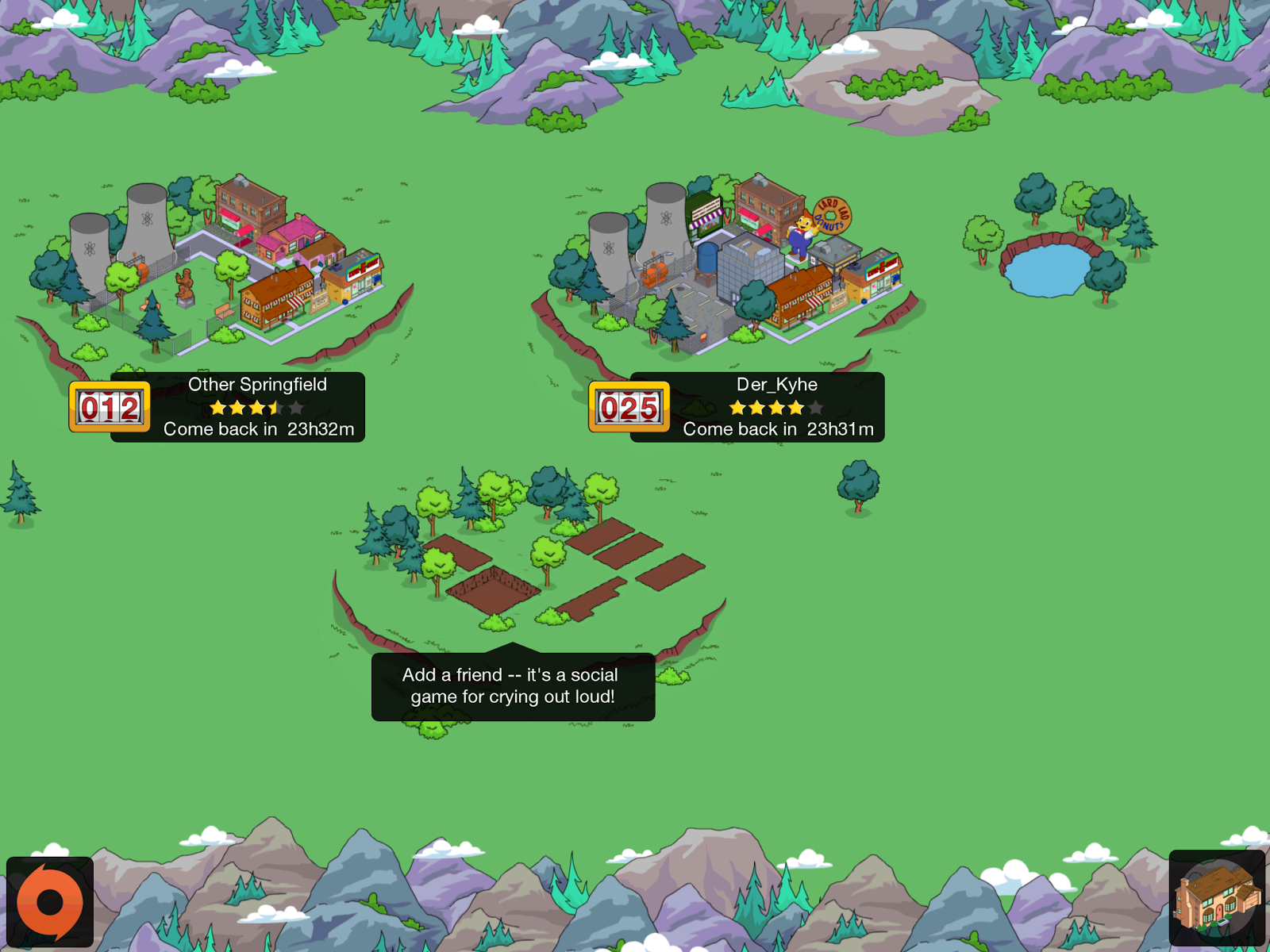
View from the neighbourhood

Tapped Out’s only social feature inside the game is the ability to visit player’s friends’ towns. In current version of Tapped Out, players visit their friends’ towns in order to send Valentine’s Day cards to the friends and thus helping friends and themselves. Cards are sent by clicking (maximum three times a day per town) the buildings in the town. By clicking buildings players gain more experience, cash and hearts for themselves and for their friends.  Hearts are special kind of in-game currency which players can use to purchase special Valentine’s Day items (limited time around Valentine’s Day). Sending Valentine’s Day cards to friends is easy and rewarding way to integrate the social aspect in the game since it compels users to invite their friends to the game as well.
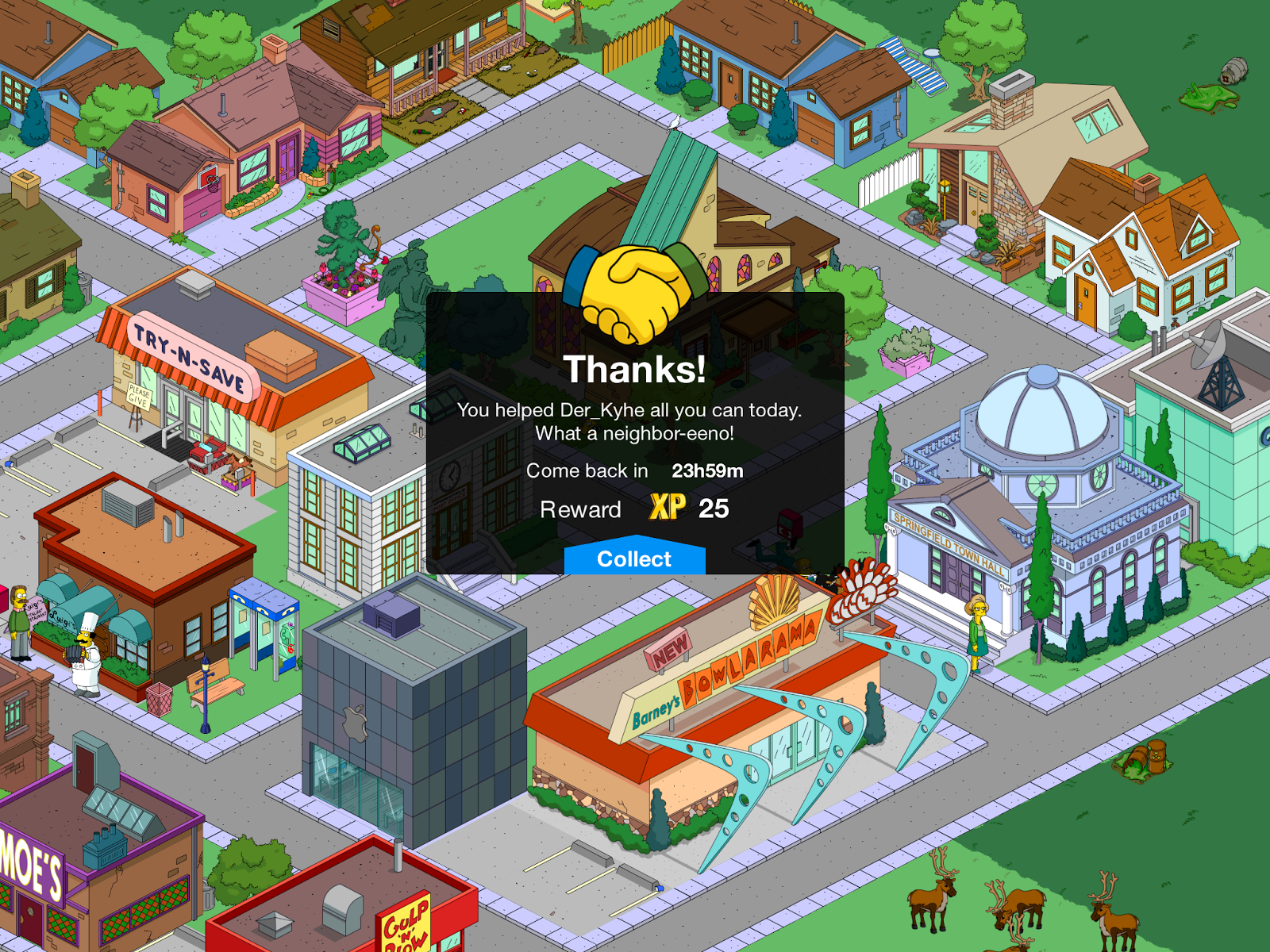
Sadly this is as far as the game gets in the social mechanics. It’s sad because social mechanic doesn't really affect any other part of the game than the player receiving more experience and in-game currency. Secondly the only feature which the game includes in terms of social aspects is exactly the same thing what e.g.  Zynga did back in the days with their first Facebook games including FarmVille.

It would have not taken much effort to introduce little bit evolved social mechanic to the game where users could help their friends by integrating the help features more into the core loop of the game. 

The Monetization


It’s interesting to see the level of of the cheapest currency-pack goes up and up when the platforms and games evolve. Before iPhone was launched back in the days, Travian, Farmville and bunch of other social games started at 0,49€ currency packs. Now the usual starting price seems to be something like 4 to 5 euros.

In Tapped Out, the minimum price for currency pack is 1,79€ which is mystery for me why that is so low. 
In Tapped Out, player pays for speeding up the progress (constructions and chores) of the game as well as by paying from some special items and buildings. And there’s a LOT of items you can buy only with hard currency. From most expensive item the player has to pay 250 donuts and all the premium stuff together is worth of 2743 donuts. With a maximum one-time IAP of 2400 donuts wih 89,99€

Because the game is so well optimized for DAU (as I explain later), the game could monetize better the players who doesn't want to wait. Now all the waiting is tied to the max 24-hour cycle which decreases the conversion rate from players to payers. 

Engagement

Biggest element for high engagement and thus retention rates are well balanced core-loop and compelling, tablet-optimized gameplay. Core loop is designed to keep DAU high because every task of the characters, building & tax income times of the buildings doesn’t exceed 24h. In addition, the way the rewards of the tasks of the characters, finished buildings and send / received Valentine’s Day cards are showed to the player is very compelling. It’s very rewarding to come back in the next day and tap & see how the rewards fly to oneself on the screen of iPad.

Scratch-R tickets. Can you scratch the itch?

In addition to core loop, Tapped Out includes basic engagement features. First, there are the daily rewards which reward players with money for coming back daily. The cash rewards increases daily for a week and in the last day there is special lottery prize available for player.  After one week the reward loops starts again from the beginning.

Another engagement feature is Daily “Scratch-R” scratching tickets which players can buy with soft currency once per day and if they want buy more, they have to pay hard currency. These kinds of luck-elements are especially popular in Asian countries (according author’s own references) and may monetize very well there.

1st gen social game in 3rd gen platform

I think that Tapped Out is the iteration of 1st gen social game which means that the social aspects of the game doesn't really add value to the core game mechanics but rather just rewards  the player for visiting their friends town with in-game currency.

I think the game has very good retention rates and it monetizes mainly from players who would like to buy the premium stuff or the Asian players for scratching those tickets. It could do better if the game’s progression would be designed to slow down (= longer waiting) after some while from beginning of the game to create primed to spend moments.

The retention rates could be quite easily pulled even higher by enabling players to upgrade their buildings or create ad-hoc relationships between the character of their town. Now the game doesn't give any visual feedback on the progression other than giving and showing piles of in-game currency to players which they can buy more buildings.

Apart from the monetization and retention – or in conjunction with them – the game could do a hell of a lot better with integrating social aspects into the game. The first thing would have been to think easy and creative ways to collaborate and integrate fabulous Simpson characters into it. What could have been funnier than to find and catch (read: tap) “the lost cats of Crazy Cat Lady” and send them back to a friend from whose Crazy Cat’s are they? Or how about enabling players to create their own baseball league championships after they have managed to build the stadium and invite their friends to take part in it? There’s a tons of more good and easily implementable ideas from the franchise which could have been integrated into the game to create more social game.

Apart from the social aspects, I think EA is quite pleased with the numbers what the game has done but I sincerely hope that EA has some ideas waiting to get implemented so that the players would get more value from this social game. Now it just seems that EA has went easy but hollow way of creating social game by copying the basic design principles from early Zynga games which creates good numbers for EA due to high discoverability of The Simpsons franchise, heavy user acquisitions and 24h optimized (but still hollow) progression loop. Simply put it's fist gen social game on a third gen platform.

Monday, January 13, 2014

Supecell's next game Boom Beach analyzed


As most eager fans have already seen, Supercell has been testing their next mobile game Supercell in Canadian App Store. Boom Beach was launched in Canada in 8th of November 2013 and it still is "under testing" in Canada.

Let's dig through the main game pillars of the game, analyze how it differs from Clash of Clans in terms of gameplay, monetization and engagement aspects and finally, let's discuss how these changes might affect the core audience of the game.

Gameplay

Baseview from Boom Beach
For any of you who don't know what Boom Beach is, it is a strategy management game - similar to Clash of Clans. The main goal of the game is to develop one's own military base and conquer surrounding islands from AI-players and other human players by accessing the map view from in-game ui.

Obviously, the first main difference is that instead of medieval-fantasy theme what is used in Clash of Clans, the theme is now military. Basic troops consists of Riflemen, Heavys, and Zookas which all have their own strengths and weaknesses and basic buildings are military bases, residence buildings, gold storages, sniper towers, mortars and machine guns, to name a few.

Second distinct difference is that battles against AI-controlled enemies and human opponents can be accessed from one single map view.  How much world is uncovered from fog of war depends on the level of the Radar building and the urge of the player to spend gold to unlock areas from fog of war (unlocking areas costs gold, you know). 

Third big difference in the gameplay is that controlling of troops in the battle is a little bit more direct now. In Boom Beach player can control the target position of all the units in the battle by placing a flare in to the position where he wants the troops to go. But the tricky part is that the flares last only a certain amount of time and when they end, troops will start to attack to the nearest possible building from their position. So if the target position of the flare is too far away from the troops, they will never make it so far and might disrupt the whole attack plan of the player.

Fourth big difference in the battle mode of Boom Beach compare to Clash of Clans is the introduction of energy points and consumables to battles. Here's how they work: first, the base amount of energy points the player has is dictated by the level of the gunboat - the better the level the more energy points. Secondly, players can collect energy points during battles by destroying enemy buildings. Thirdly, player can use these energy points to use consumables such as flares, artillery, medkits and shock bombs which could have a big impact to the battle if used wisely.

And finally, the fifth big difference in the battles in Boom Beach is that the Headquarters acts as "all or nothing" type of building which means that if enemy can destroy the Headquarters, the battle is lost. Also, the health level of Headquarters is an effect of health level other buildings in the village. This means that if enemy can destroy the gold storage of your camp, the health of Headquarters decreases a bit. However, this doesn't mean that by destroying all other buildings in the camp, the result would be destroyed Headquarters.

In my opinion, with these design decisions, Supercell has created a game which is more "core" than it's previous game Clash of Clans mainly because of the depth of the battles. At least for me, there are far more variables to consider when planning the attack against other players and maybe that's why Supercell hasn't limited the amount of time the player can scout camps of enemy players. Also, fewer unit amounts and more direct controlling of the troops during battles creates more engaging battle gameplay experiences for the players.

Monetization

In terms of monetization there are quite a few elements to inspect to really get a grip on monetization aspect of the game

Virtual Currencies and Resources
First, let's go through types and amount of virtual currencies and resources in Boom Beach. There are three different types of virtual currencies in Boom Beach: Gold, Wood, Stone, Iron and one premium currency Diamonds. 

Gold is produced by the residence buildings; the more the player has these and the higher level they are, the more they produce gold in an hour. 

Wood is produced by Sawmill to which the same rules apply - the higher the level, the more it comes.

Stone is produced by the Quarry.

In addition to these basic resource production building which are directly accessed by the player, considerable amount of gold, wood and stone comes from the resource bases and which are conquerable by the human opponents in the game. Player can also gain these resource by winning battles in the game.

Gold is mainly used to train more units, to clear more area in the map, to fight battles and to research better types of power-ups from the Combat Academy. These are all "gold only" types of productions. Wood and stone are mainly used to construct and upgrade buildings and gunboat in the home base. 

From my gameplay experience it seems that stone is the most rare and sought after resource at least to player HQ level 7 (I have no experience from iron yet) . Also, the need for the "next-available-to-be-produced resource" starts before the resource production building is available for construction. For these cases, the only possible way to get these resources are by winning battles which increases the engagement of the game in these occasions.

Premium currency is used to speed up the training of units and to construction or upgrading of buildings so there are no special building types or items (at least not yet).

Builders
One of the most striking differences between the two games and clear differentiation from other mobile strategy management games is the absence of any type of builders in the game. There are no builder's hut or carpenter's hut or any other conveniently named item which they player could purchase from the building menu with premium currency. 

In-App Purchases
Premium currency diamonds is possible to buy with real money and they come in packs. The price points for different packs are 
4,99USD/4,49€ (500 diamonds), 
9,99USD/8,99€ (1200 diamonds), 
19,99USD/17,99€ (2500 diamonds), 
49,99USD/44,99€ (6500 diamonds) and
99,99USD/89,99€ (14 000 diamonds).

The price points of premium currency packs and the amount of premium currency in them are exactly the same than in Clash of Clans.

Progression speed
When I refer to progression speed within a f2p game I mean the pace of new content which is available for player whether it is through levelling up their experience level or upgrading the town hall, headquarters or by any other means. From developer's perspective this also means that how fast the content is being consumed.

In general, progression speed in Boom Beach is faster than in Clash of Clans. I have played Boom Beach irregularly now for about two months and my Headquarters is already in level seven, in the same level than my Clash of Clan's Town Hall. 

In my opinion, the biggest motivation for player's to spend premium currency is speeding up the training of troops. That's because there's not so much premium items to be purchased and because the core-loop with social aspects creates so strong motivation to engage to battles that players just don't want to sit and wait for their troops to be trained.

Retention, Engagement, Social

Like it has been discussed by fellow developers elsewhere, retention is number one metric for the success of free-to-play game because, in essence, they tell how good the game is. Also, every time publisher can increase retention percent, the chance to get more revenue from the user-base increases as well. 

Core-loop of the game affects partly to the success of the game and to retention percent of the user within it. I comprehend that well-balanced core-loop is one part of good retention and the other one are the social mechanics and their implementation in the game.

In Boom Beach, the core-loop is downrightly similar to that of Clash of Clans: player can collect resources, construct buildings, train troops and engage to battles. As discussed, there are big differences within that loop, but the basic building blocks of loop are the same.

Player can access both battles, against AI-controlled enemies and PvP fights from the same map view.


What comes to social mechanics of Boom Beach, there are no clans, no troop donations and no top lists. First, this might seem as a big impediment until the player understand how the dynamics of resource production, battles and building & training work.

First important thing to understand of the dynamics is that bases which player has captured do not last forever in his possession. They can be conquered by the AI-controlled Blackguard or by fellow players who are playing the game. And then you - as a player -  have to conquer them back if you do not want to lose your bases or your medals. This same loop goes on the rest of the game and it's the core mechanic in the game which drives up engagement rates, since if player wants to keep up the control of the bases, he has to engage to battles daily.

Second thing - which mostly affects to retention rates - is the introduction of fellow players within the game. Very early in the game play, player stars to notice that there aren't only the AI-controlled Blackguard bases in the map, but also bases controlled by other players. Although Supercell could a lot more in terms of visualizing the progression level of players in the map (currently only thing which visualizes the level of the player is number which is located besides the base icon), fighting against other players and conquering their bases is very motivating force to develop one's own base and troops. This is because the introduction of other players happens in the context and view of the game and the core loop and the actual event is important part of the core gameplay.

Summary

At least during testing phase still and at first glance, Boom Beach might seem as a stripped-down version of Clash of Clans but I think Supercell is doing the right thing because of following things:
1) The game  is still in soft launch period meaning that only the core of the product is released and new stuff is being added all the time. Who knows what they have planned for the global release?
2) The game is more "core" than Clash of Clans due to more direct controls and in general, the player has more influence to events and the end results of the battle. Being more core is also a valid thing to do in terms of platform mature and guiding the existing player-base from Clash of Clans to Boom Beach. 
3) Improving things here and there based on the feedback of the players. Supercell has the player base already which are accustomed to play "mid-core" strategy management games and Supercell has gathered vast amount of feedback from them which they can and apparently utilize in Boom Beach. Win-win situation for both.

That being said, it might be that Boom Beach will never see a global day-light, if the numbers don't count up in the end of the soft launch period. Can't wait to see how it all turns out!